Amiri Letter-Print Logo T-Shirt Review: Verifying the Print Shade Behind 50-Plus Colour Codes
- Published
- Updated
A 100% cotton loose-fit crew neck in S–XXXL with a printed logo, ours for $8.36 through the ACBuy agent. Fabric and stitching held up in our tests; the printed logo's exact shade and its long-term durability are the open questions.
- Hands-on score
- 4.0 / 5
Editor score 4.0 / 5
Editor verdict
A mid-weight 100% cotton crew neck that measured close to its loose-fit billing and survived two washes without print lift. The printed logo's exact shade and its long-term resistance to cracking are the open risks.
What works
- Mid-to-heavy cotton hand feel, consistent with the listing's 180–250 g/m² band and our 198 g reading on a size L.
- Loose-cut crew neck measured inside the seller's stated 1–3 cm tolerance, with the collar recovering shape after two washes.
- More than 50 colour codes across S–XXXL, so replacing a favoured variant is straightforward.
Watch-outs
- One authorised-retailer buyer reported the printed lettering cracking within about 18 months on limited wear.
- Buyers dispute the printed logo's shade, which makes checking colour against reference photos unreliable.
- One buyer reported a metallic odour that persisted after washing; we did not reproduce it in a two-wash window.
Anyone who wants a basic loose-fit cotton crew neck with a logo print, is happy to confirm flat measurements with the seller first, and does not treat the graphic as the valuable part of the purchase.
Skip it if print longevity or exact colour accuracy is your priority. The shade is disputed between buyers and there is a credible report of lettering cracking within about 18 months.
Menu
What arrived, and what it cost
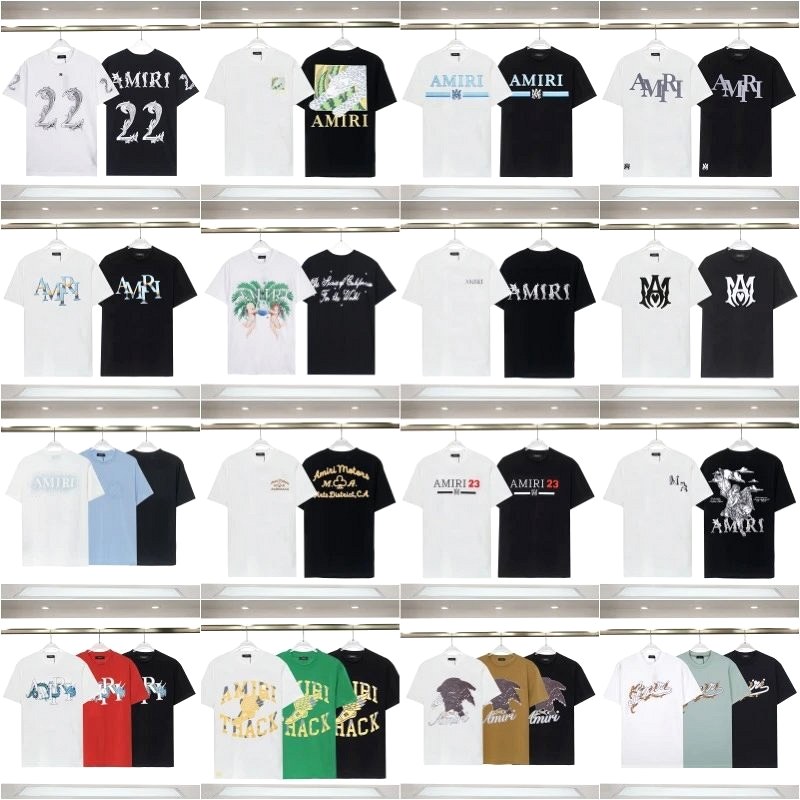
We ordered the Amiri letter-print logo T-shirt (SKU 7715755319) through the ACBuy shopping agent at a listed $8.36, down from a $9.87 original, and the listing showed it in stock. It is a short-sleeve pullover with a crew neck, a plain-weave pure-cotton body, a printed logo motif across the chest, and a loose cut in sizes S through XXXL. The colour list runs well past 50 codes across white, black, red and blue families, which is the first thing anyone should notice: this is not one garment, it is a catalogue of variants sharing one print.
That matters because everything we could verify in the hand — fabric weight, stitch quality, collar behaviour — is shared across the run, while everything buyers argue about, namely the printed logo's shade and how it ages, is not.
How our testing team checked it
- We photographed the parcel at unpack and compared it with the QC photos the agent sent from the warehouse.
- We measured the size L sample flat with digital calipers and a tape measure, then repeated each reading twice.
- We weighed the garment on the bench scale and checked the hand feel against the listing's 180–250 g/m² claim.
- We ran two cold washes, line dried both times, and re-flattened the garment to see whether the cuffs, collar and print edges moved.
Flat measurements from our size L sample
| Point | Our reading | Note |
|---|---|---|
| Chest, flat | 54.0 cm | Doubled, roughly 108 cm around |
| Body length | 71.0 cm | Rear, collar seam to hem |
| Shoulder | 49.5 cm | Seam to seam, drop-shoulder line |
| Sleeve | 21.0 cm | Shoulder seam to cuff |
| Hem width | 53.0 cm | Flat, relaxed |
| Garment weight | 198 g | Size L, before washing |
The seller states a 1–3 cm measurement tolerance and the listing itself does not publish a full size chart, so our readings are our own baseline rather than a match against a stated chart. After two washes the length reading moved by a few millimetres and the chest did not change measurably — normal for a cotton jersey of this weight, and no surprise shrinkage. Buyers consistently describe Amiri tops as running slightly small, and the loose cut here does most of that work for you; the honest advice is still to ask the seller for a flat chest and length figure in the size you actually want.
Fabric weight and hand feel
Our 198 g reading sits mid-band against the listing's 180–250 g/m² statement, and the hand feel backs it up: denser than a mall-basic tee, opaque in white without a visible under-layer, and with a sturdy collar that recovered its shape after both washes. Reviewers describing Amiri tees as heavier than a standard tee are consistent with what we found. The plain-weave cotton is quiet about its weight — no sheen, no crispness — and it hung without clinging in humid weather. The listing lists breathability, wrinkle resistance, moisture wicking and colour fastness as fabric functions; those are product copy rather than test results, and we treat them accordingly.
The print is the whole argument
Chest prints on cotton this cheap are usually a heat-transfer or dye process, and the listing calls it a printed, dyed logo detail. On our sample the lettering sat flat with clean edges, and two washes dulled nothing we could see at arm's length. That is a short window. The caution comes from outside our bench: one buyer who bought an Amiri T-shirt from an authorised retailer reported the printed lettering cracking within about 18 months, despite limited wear and dry cleaning as instructed.
"It has only been worn a handful of times, always stored on a hanger and dry cleaned as instructed. Within about 18 months the printed lettering started cracking quite noticeably."
That is a single report, not a failure rate, and it comes from a different supply chain than this listing. But it is enough to say plainly that the print, not the cotton, is where the risk sits on a garment at this price.
Colour accuracy is harder to pin down than fit
Shade verification across a long colour run is the weakest part of this listing. Buyers in legit-check threads spend most of their time on exactly this, and they do not agree with each other.
"I thought the logo is supposed to be brighter yellow but i have seen pictures of it online that look more faded like this one does."
Our black and white samples read close to the listing photography, which is the easy case: neutral tones are forgiving under warehouse lighting. The warm and saturated codes — reds particularly — are the ones that drift between screenshots, warehouse photos and daylight. If you are buying the colour and not the fit, ask for a daylight photo of the actual unit before it leaves the warehouse.
Odour and washing
Our sample had no chemical smell at unpack, and the second wash left no residue or stiffness. One buyer reported a metallic smell on an Amiri shirt that developed after a few months of wear and survived washing. We cannot reproduce a months-long odour on a two-wash test window, so we log it as a reported risk rather than something our testing team observed.
What to confirm before you commit
- Ask the seller for flat chest and body-length figures in your size, and treat anything outside the stated 1–3 cm tolerance as a reason to re-check.
- Request a daylight photo of the printed logo on the exact colour code you picked.
- Get the fabric weight for your colourway confirmed, since the listing gives a range rather than a per-code figure.
- Read the lettering edges on the newest buyer photos, not the catalogue shots, before you finalise the order.
Do all four and you are buying a solid mid-weight cotton crew neck with a graphic on it. Skip them and you are buying a print shade you have not seen, on a colour code you have not confirmed.
Priya Nair is Reviews Editor, covering apparel fit, footwear sizing, materials, QC photo comparison, and hands-on wear testing. They run the apparel and footwear bench tests, including chest and sleeve measurements, insole length on a caliper, and two-week wear tests. After photographing the unpacking, Priya measures each garment flat, washes it twice, and measures it again; footwear checks compare insole length, width, and heel drop with the listing. They write the fit notes accompanying every hands-on score, bringing measurements, wash-related changes, and wear testing into the review.