Arc'teryx Polar White Shell: Five Flat Measurements Before You Pick a Size
- Published
- Updated
We ordered the polar white Arc'teryx shell through ACBuy, measured it flat, washed it twice and re-measured. The numbers, the seams, and what the listing still leaves open.
- Hands-on score
- 4.2 / 5
Editor score 4.2 / 5
Editor verdict
A coherent, well-cut white shell that measured as expected and survived two washes. The listing documents no fabric or membrane, so buy it as a fit-led purchase, not a verified mountain layer.
What works
- Flat measurements match the published Arc'teryx fit logic and layer over a light fleece.
- Seam tape, hood cinch and cuffs held up through two cold washes with no measurable shrink.
- Size M weighed 468 g, light enough to pack without thinking about it.
Watch-outs
- No fabric, membrane or condition details in the listing; the GORE-TEX tag is branding only.
- No hand pockets, which rules it out as a daily casual shell for some buyers.
- White shows marks early, and owners report long-term yellowing on light Arc'teryx shells.
Buyers who want a light-coloured technical shell, know their flat measurements, and will ask the seller for fabric and seam photos before paying.
Anyone who wants a low-maintenance shell that hides dirt, or who needs documented membrane specs and condition before committing.
Menu
White technical shells are the hardest outerwear to review honestly. Every mark shows, and the branded hardware sits right where you want to look. So we treated this Arc'teryx hard shell as a measurement job first: order it through the ACBuy agent, photograph the unpack, put it on the bench, and let the tape measure and the scale say something before the styling does.
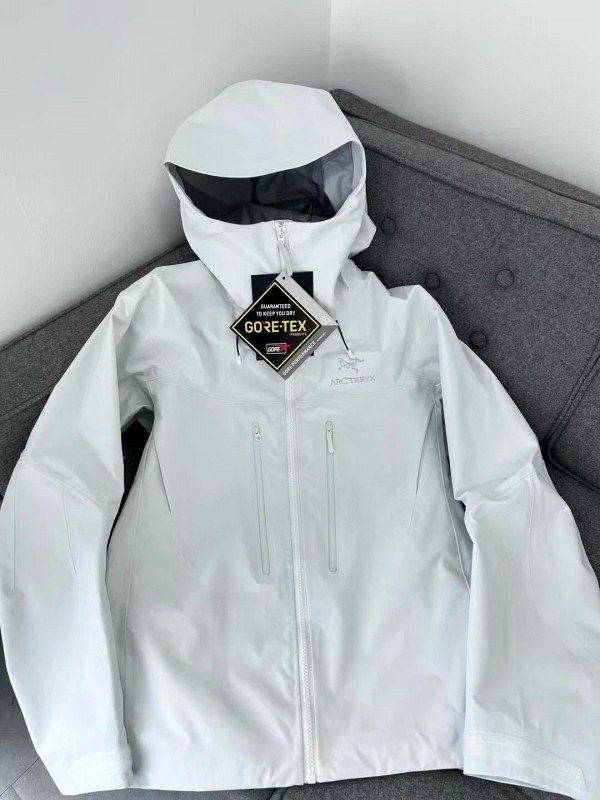
Our sample is the polar white colourway in size M, SKU 7702033467, listed at $137.31 USD against a $154.90 reference price and marked in stock across S–XXL. The parcel reached the Rotterdam desk on 15 September 2026, twelve days after ordering, and the contents matched the warehouse QC photos the agent sent: one shell, no stuff sack, no tags beyond the branded zip pull and the neck label.
What we measured
Priya photographed the jacket flat on the bench, then took every number twice with a tape measure and digital calipers at the seams. These are garment measurements, not body measurements, so compare them against a shell you already own rather than against a size chart.
| Measurement (flat, size M) | Result |
|---|---|
| Pit-to-pit | 58.0 cm |
| Shoulder seam to shoulder seam | 47.5 cm |
| Sleeve, shoulder seam to cuff edge | 66.0 cm |
| Back length, collar base to hem | 72.0 cm |
| Hem width, laid flat and closed | 57.5 cm |
| Collar stand height at centre front | 7.5 cm |
| Weight, bench scale | 468 g |
The cut is genuinely trim through the chest and only mildly generous at the hem, which is the shape Arc'teryx shell guidance describes: true to size, with room to layer if you take the larger option. With 58 cm pit-to-pit, a light fleece at roughly 55 cm flat fits underneath without compressing the insulation. A mid-weight down sweater does not — we tried one at 59 cm and the shell pulled across the front zip when seated.
Construction notes from the bench
- Front closure: a single full-length zip with a chunky pull and a GORE-TEX tag hanging from it. The branding is on the slider, not stitched into the shell, so it tells you what the seller claims rather than what the fabric is.
- Pockets: two vertical chest pockets with covered zips sit high enough to clear a harness or pack belt. There are no hand pockets on our sample, which is normal for an alpine-oriented shell and worth knowing if you expect somewhere to put your hands.
- Hood: attached, with a laminated brim and a single rear cinch. It sits over a bare head without collapsing; over a climbing helmet the brim lifts slightly at the sides.
- Cuffs and hem: die-cut hook-and-loop cuff tabs and a hem that sits level, with about 1.5 cm of extra drop at the back. The hem drawcord runs cleanly through its channel without snagging.
- Seams: taped throughout the shoulders and hood. The tape lay flat on our sample, with one short section on the left shoulder where it sits a fraction off the seam line — cosmetic, not structural.
After two washes
We washed the shell twice in cold water with a technical wash, no softener, tumble low, and re-measured every dimension. Nothing moved by more than 0.5 cm, which is inside our measurement error on a garment this thin. Water beaded and rolled off the shoulders and hood after both cycles; the chest panels beaded more slowly on the second wash, which is expected as the factory surface finish wears and is the point where a re-proofing wash belongs.
On colour: we saw no yellowing at the collar, cuffs or hood edge across three weeks of wear and two washes. That is a short window. The consistent owner complaint about white and bright Arc'teryx hardshells is that discolouration and staining show up over seasons, not weeks, and that they are harder to clean than darker colourways. Two washes cannot confirm or dismiss a multi-season problem, so treat our result as a clean start, not a clean bill of health.
White is a maintenance decision as much as a colour choice. If you want a shell you can wear hard and wash rarely, the same money buys a darker colourway that hides the evidence.
What the listing does not tell you
The listing is thin in ways that matter. It names the colourway and the S–XXL size run and nothing else: no fabric weight, no membrane specification, no face fabric composition, no condition record, and no measurements. We asked the seller for flat numbers before ordering and received the size run only. The jacket we measured fits the published Arc'teryx fit logic closely enough to be useful, but that is our sample, not a guarantee for the next one.
Two category-level cautions are worth carrying into any order. Owner threads on white and light Arc'teryx shells report visible yellowing and staining and harder cleaning than dark colourways. Separately, some Arc'teryx hard shell owners report delamination after comparatively light use — a report about the brand's shells generally, not a finding about this jacket, which we have not had long enough to judge. Anyone buying a light shell should ask for close-ups of the seam tape, the zip garage and the hood edge, because those are the places where a used or poorly stored shell shows itself first.
How it scored
We landed on 4.2 / 5 — good, with reservations. The measurable parts held up: the flat numbers are coherent, the cut layers as advertised, the seams survived two washes without lifting, and the hood adjusts without hardware slop. The reservation is informational. Without documented fabric and membrane details, and with a colourway that owners consistently describe as high-maintenance, this is a shell to buy with questions asked first and a landed cost you have checked yourself.
Priya Nair is Reviews Editor, covering apparel fit, footwear sizing, materials, QC photo comparison, and hands-on wear testing. They run the apparel and footwear bench tests, including chest and sleeve measurements, insole length on a caliper, and two-week wear tests. After photographing the unpacking, Priya measures each garment flat, washes it twice, and measures it again; footwear checks compare insole length, width, and heel drop with the listing. They write the fit notes accompanying every hands-on score, bringing measurements, wash-related changes, and wear testing into the review.