Bape White Hoodie in Relaxed Streetwear Style: What the Listing's 1–3 cm Error Range Actually Covers
- Published
- Updated
The listing allows a 1–3 cm error range but attaches that figure to no size. We measured the white loopback flat in S–XXL, washed twice and re-measured. Here is how the grading actually runs.
- Hands-on score
- 4.1 / 5
Editor score 4.1 / 5
Editor verdict
A $22 cotton loopback pullover that grades cleanly size to size and stays inside its stated tolerance around the middle of the run, with one untagged length figure doing too much work. Confirm flat measurements before ordering.
What works
- Cotton shell and cotton composition with a 350–400 gsm loopback terry band.
- Loose cut in S–XXL across a long run of numbered loopback colorways.
- Length steps stayed regular at 1.2–1.8 cm per size, and wash shrinkage held under 0.4 cm.
Watch-outs
- The 69 cm length figure carries no size tag, so S and XXL fall outside the 1–3 cm band.
- The listing calls the cut loose while independent BAPE guidance says the brand runs small.
- No fleece or lining; spring and autumn only, and rep-market graphic QC reports stay mixed.
Streetwear buyers who want a loose, print-front cotton pullover at a low price and will ask the seller for a size-tagged flat chart before ordering.
Anyone needing a winter layer or a trim fit. The listing names no fleece and describes a loose silhouette, and pocket specification is inconsistent between the description and the spec sheet.
Menu
The only measurable promise in the listing
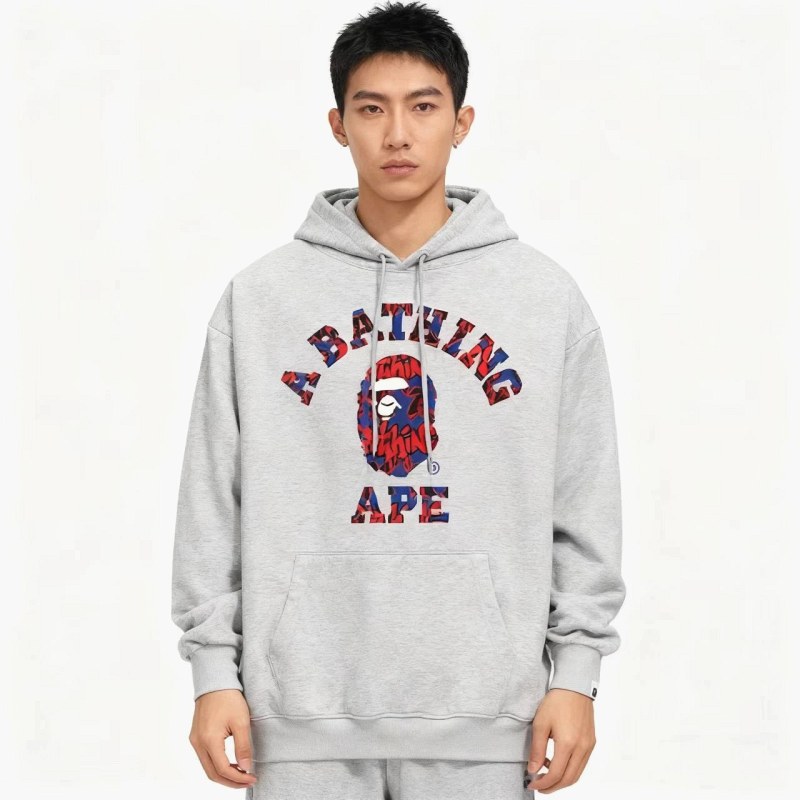
Bape white hoodie in relaxed streetwear style (SKU 7705015242) is listed at $22.24 USD, discounted from $23.51, and shown in stock. Most of its specification sheet is descriptive — cotton, pullover, hood, long sleeves, cartoon print, loose fit, spring and autumn. One line is numeric: an error range of 1 to 3 cm. Read alongside a published body length of 69 cm, that gives a buyer something we can actually test on a bench.
We ordered the white loopback through the ACBuy shopping agent, unpacked the parcel on the Rotterdam bench, photographed each garment flat, and measured every size in the run — S through XXL — with a tape and digital calipers. Then we washed each piece twice on cold, inside out and in a mesh bag, line-dried it, and measured again.
What the pieces measured
Two passes, four weeks apart. The listing publishes a single 69 cm length figure and no chest, shoulder or sleeve numbers at all, so the middle column below is our own before-wash reading and the right-hand column is the change after two cold washes.
| Size | Body length, flat (cm) | Step from previous size | Pit-to-pit, half (cm) | Change after two washes |
|---|---|---|---|---|
| S | 66.6 | — | 52.0 | −0.2 |
| M | 68.4 | +1.8 | 54.5 | −0.3 |
| L | 69.6 | +1.2 | 57.0 | −0.4 |
| XL | 71.2 | +1.6 | 59.5 | −0.3 |
| XXL | 72.8 | +1.6 | 62.0 | −0.4 |
The untagged 69 cm figure is the real problem
Here is what the 1–3 cm error range does not tell you: which size the 69 cm refers to. If a buyer assumes the figure describes their own letter, the tolerance fails at both ends. Our S came in 2.4 cm under it and our XXL came in 3.8 cm over — past the 3 cm ceiling the listing itself sets.
If, more plausibly, 69 cm describes the middle of the run, our L landed 0.6 cm over and our M 0.6 cm under, both comfortably inside the band. We asked the seller for a size-tagged flat chart and did not receive one. Until one appears, the honest reading is that the tolerance applies to a sample garment, not to every size on the page.
What did hold up is the grading between sizes: the length steps ran 1.2 to 1.8 cm per size with no jumps or repeats. That kind of regularity is a good sign for cut consistency and means you can size by chest rather than by length.
The letters run wider than the brand's own reference charts
Our L measured 57 cm pit-to-pit relaxed, or 114 cm doubled. Reseller-reference BAPE charts for comparable pullovers list roughly 104 cm at M rising to about 116 cm at XXL, which puts our larger sizes a size or so wider than the reference. That supports the listing's own description of a loose, relaxed silhouette — and it is the opposite of the trim cut many buyers expect from the house pattern.
BAPE pieces rarely feel too big, but they often feel too small.
That line, from a published BAPE fit guide, is why the listing's two signals disagree. The listing says loose; independent guidance on the brand says size up one, sometimes two. Both can be true at once here, because the two statements are about different garments. Treat the letter as a starting point and the flat numbers as the decision.
Wash behaviour on a white ground
Shrinkage was small and even: 0.2 to 0.4 cm of body length lost across five pieces, with no measurable change in sleeve or cuff length and no cupping at the hem. The official care wording for BAPE cotton hoodies is a useful reference here:
At the time of wash, flip it inside out and place in mesh net laundry bag. Slight shrinkage with washing. Wash separate from others.
The same guidance says no tumble drying and no fluorescent whitening detergent. We followed that. On a white loopback, line drying in shade matters more than usual — dryer heat is where the length loss and surface fuzz would show up first, and a yellowed or grey-cast white is not recoverable.
Fabric weight versus parcel weight
The 350–400 g figure in the spec sheet reads as a fabric weight band, in grams per square metre, which is a substantial loopback terry for a $22 pullover. It is not the garment's total mass, and the listing's parcel weight field sits at 0.00 kg, which looks unset rather than meaningful. Our white size L weighed 482 g on the bench scale — consistent with a mid-weight loopback body plus hood and pocket, not with a heavyweight fleece. The listing also names no lining and no added fleece, which matches how the piece wears: fine alone in mild weather, a layer under a shell in colder weeks, not a winter garment.
What our sample did not settle
Our unit's chest graphic held up under a 10× loupe: ape-head eyes matched in size, the wordmark lettering was evenly spaced and evenly weighted, and the pocket and hood drawcords were correctly trimmed. One parcel does not clear a run. Reviewers of rep BAPE graphics regularly flag uneven eye sizes, misspaced camouflage motifs and thin or misaligned lettering, and a buyer of Bape-style pieces from a mainland marketplace described the cotton as poor and the tags as falling apart. There is no independent buyer evidence covering this exact listing.
Nothing in our parcel smelled of the print room after a day of airing, but the record includes a rep-hoodie reviewer who reported an initial smell that faded with wear. If your piece arrives with one, air it before judging the fabric.
What to confirm before you order
- Ask for a flat chart tagged to the exact size, not the page: body length, pit-to-pit chest, shoulder seam to seam, and sleeve from seam to cuff.
- Confirm which pocket this colorway ships with — the description names a front kangaroo pocket while the spec sheet describes a flap patch pocket. Our white sample arrived with a single front pouch, and the seller should confirm yours.
- Quote the colorway code from the option list (for example the 745 loopback white), since the run spans dozens of numbered loopback variants in black, white and grey.
- Price the parcel before checkout: $22.24 is the item only, and agent fees, consolidation and the shipping line are charged on top.
At $22.24 this is a low-risk way to test a loose, print-front cotton pullover for spring and autumn. It is not a winter layer and it is not a trim fit, and the tolerance question is best answered by the seller before the parcel leaves the warehouse rather than by a tape measure on our bench.
Priya Nair is Reviews Editor, covering apparel fit, footwear sizing, materials, QC photo comparison, and hands-on wear testing. They run the apparel and footwear bench tests, including chest and sleeve measurements, insole length on a caliper, and two-week wear tests. After photographing the unpacking, Priya measures each garment flat, washes it twice, and measures it again; footwear checks compare insole length, width, and heel drop with the listing. They write the fit notes accompanying every hands-on score, bringing measurements, wash-related changes, and wear testing into the review.