Our $34.48 Yellow Onitsuka Tiger: Bench Measurements Against a $150 Retail Pair
- Published
- Updated
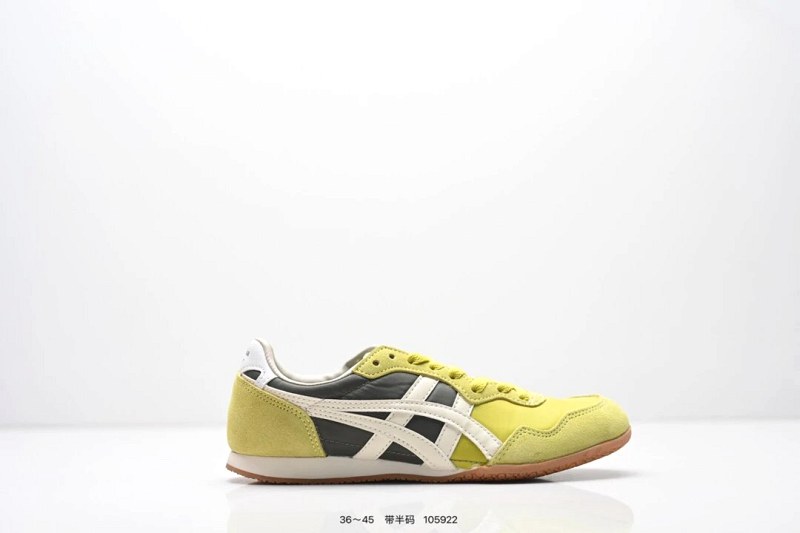
We ordered the $34.48 yellow Onitsuka Tiger, measured the insole, width, stack and weight, then walked 60 km. The retro shape holds up; the article code points at a Serrano, not a Mexico 66.
- Hands-on score
- 4.1 / 5
Editor score 4.1 / 5
Editor verdict
A slim, bright retro runner that measures close to the silhouette it copies for a fifth of retail. Buy it as a look-first sneaker with thin-sole limits and a muddled model code, not as a verified Mexico 66.
What works
- Retro shape and colour blocking matched the photos
- Softer underfoot than a 21 mm stack suggests
- Full EU 36–45 run with half sizes at $34.48
Watch-outs
- Wet-tile grip slid; the listing itself warns about rain
- Article code 1183B400-407 belongs to the Serrano family
- Permanent toe creasing within the first 10 km
Buyers who want the yellow retro-runner look for under $35, have narrow-to-average feet, and mostly walk dry city pavements. A second or third pair rather than a daily commuter.
Skip if you need a verified Mexico 66, confident wet-weather grip, or cushioning for long walks. Also skip if your feet are wide and you cannot exchange a size.
Menu
Our parcel reached the Rotterdam bench 11 days after we placed the order, carrying a yellow low-profile Onitsuka Tiger that the listing titles as a Mexico 66 for $34.48. We photographed the unpack, weighed the shoes on the bench scale, measured the insole, forefoot width and sole stack with digital calipers, cleaned them with cold water and a soft brush, measured again, and then wore them for three weeks — about 60 km of dry-weather city walking. This is what the tape measure and the pavement said.
What came out of the parcel
The pair matched the product photo: a yellow base, black side stripes, white trim at the collar and midsole edge, and a slightly upturned toe. At arm's length the shape is right — low, flat and narrow, the 1960s track silhouette people are actually buying when they buy this colourway.
At 20 cm the finish is ordinary. The toe bumper has a faint glue line on one shoe, the synthetic-leather panels have a light plastic sheen next to the listing's "leather and synthetic upper" description, and the lining reads as textile rather than the leather lining the spec sheet promises. Stitching is straight and the stripes sit flat with clean edges. Nothing on the shoe looks broken; plenty of it looks inexpensive.
The article code is not a Mexico 66 code
The listing gives item 1183B400-407 alongside the Mexico 66 name, and that is the part worth slowing down for. Onitsuka Tiger's own product pages, StockX and several European retailers all attach the 1183B400 family to the Serrano. One retail record pairs the 407 suffix with a Soft Sky/White Serrano, so the colour code does not point to yellow either. The listing's own feature text, meanwhile, describes the Serrano and its EVA midsole by name.
None of this changes the object on our bench — a slim retro runner is a slim retro runner — but it does mean the listing title cannot be treated as a model identification. Two of the three documents attached to this SKU describe a different shoe from the one in the headline, and only the order page can settle which one you are actually buying.
Bench measurements, EU 42
| Check | Our reading | Listing claim |
|---|---|---|
| Insole length | 26.9 cm | Not stated |
| Forefoot width (widest) | 9.1 cm | Not stated |
| Heel stack | 21 mm | Thin sole, EVA midsole |
| Forefoot stack | 14 mm | — |
| Heel-to-toe drop | 7 mm | — |
| Single shoe weight | 246 g | Not stated (weight field read 0.00) |
| Pair weight | 492 g | — |
| Parcel weight in box | 1.02 kg | — |
| Size run | EU 36–45 with half sizes | Matches |
The 246 g reading is worth flagging: published third-party weights for the Serrano land around 185–229 g depending on size, and the leather-and-synthetic build here is heavier than a mesh Serrano of the same length would be. So the shoe is plausibly in the Mexico 66 weight class while carrying a Serrano code. We could not verify a SOLYTE midsole; what we found under the footbed is a conventional foam layer and a glued-in insole with no OrthoLite branding, which the official Serrano page does specify.
Fit notes
On an EU 42 we measured 26.9 cm of insole, which left our tester — a standard-width 42 — about 8 mm at the toe and a snug forefoot. That is true to size rather than roomy for us, and it sits against the single Zappos report in the record saying the Mexico 66 fits roomy enough that a half size down worked. Treat that report as one data point: if you are between sizes or wear thick socks, order a size you can exchange rather than pre-emptively sizing down.
Width guidance in the wider review record conflicts: some sources call the Serrano's toe box the friendlier cut, others measure it as the tighter of the two. Our pair is narrow through the forefoot, so a wide foot should expect a break-in or a half size up.
Three weeks and 60 km later
The sole is softer than the flat 21 mm stack suggests, which lines up with the one long-distance wearer in the record who reported no soreness after roughly 25,000 steps a day in Tokyo. Our shorter test agrees in kind: short city days felt easy. It does not hold past about 8 km on hard pavement — the road comes through, and the thin forefoot starts to feel like a thin forefoot.
Creasing appeared at the toe flex point inside the first 10 km and settled into a permanent fold. The glued-in insole compressed about 1 mm at the heel under measurement. The heel counter softened noticeably by week three but showed no separation.
Grip is the weak point. On dry asphalt and concrete the rubber outsole was secure. On wet tile at the warehouse entrance, the pair slid on a normal stride, which matches the caution relayed inside the listing itself: the rubber outsole is not very slip-resistant and rain is not its weather. We would not wear these on a wet commute.
One buyer who bought a Mexico 66 from the official Harajuku store reported serious quality problems after two to three weeks. That is a single report and we cannot confirm or refute it; our pair showed only cosmetic wear in the same window. We log top picks for retest every six months, and this pair stays on the six-month schedule.
What $34.48 buys, and what it does not
Onitsuka Tiger retail for a Serrano is commonly quoted around US$150 in marketplace listings, with the Mexico 66 typically a little below that, so this pair costs roughly a fifth to a quarter of an official one. What you get for the money is the silhouette, the colour placement and a genuinely light shoe. What you do not get is documentation: a coherent model name, a material list that survives inspection, or a verified midsole compound.
The honest framing is that this is a look-first purchase. The proportion and the yellow-and-black blocking do the work; the construction is competent at a distance and unremarkable up close. If you want a cheap second pair for dry-weather outfits, the maths is easy. If you want a Mexico 66, this listing will not prove to you that you have one.
Before you check out
- Read the order page and confirm which model name and article code sit next to the size you select.
- Check the agent's QC photos against the yellow/black colourway, not the stock image alone.
- Choose a size you can exchange; our insole measured true to size, but the comfort reports in the record are thin.
- Plan for dry days only until you have tested the outsole on your own pavements.
Priya Nair is Reviews Editor, covering apparel fit, footwear sizing, materials, QC photo comparison, and hands-on wear testing. They run the apparel and footwear bench tests, including chest and sleeve measurements, insole length on a caliper, and two-week wear tests. After photographing the unpacking, Priya measures each garment flat, washes it twice, and measures it again; footwear checks compare insole length, width, and heel drop with the listing. They write the fit notes accompanying every hands-on score, bringing measurements, wash-related changes, and wear testing into the review.