Bape Camo Zip Hoodie: Fit Conflict & Field Issues Review
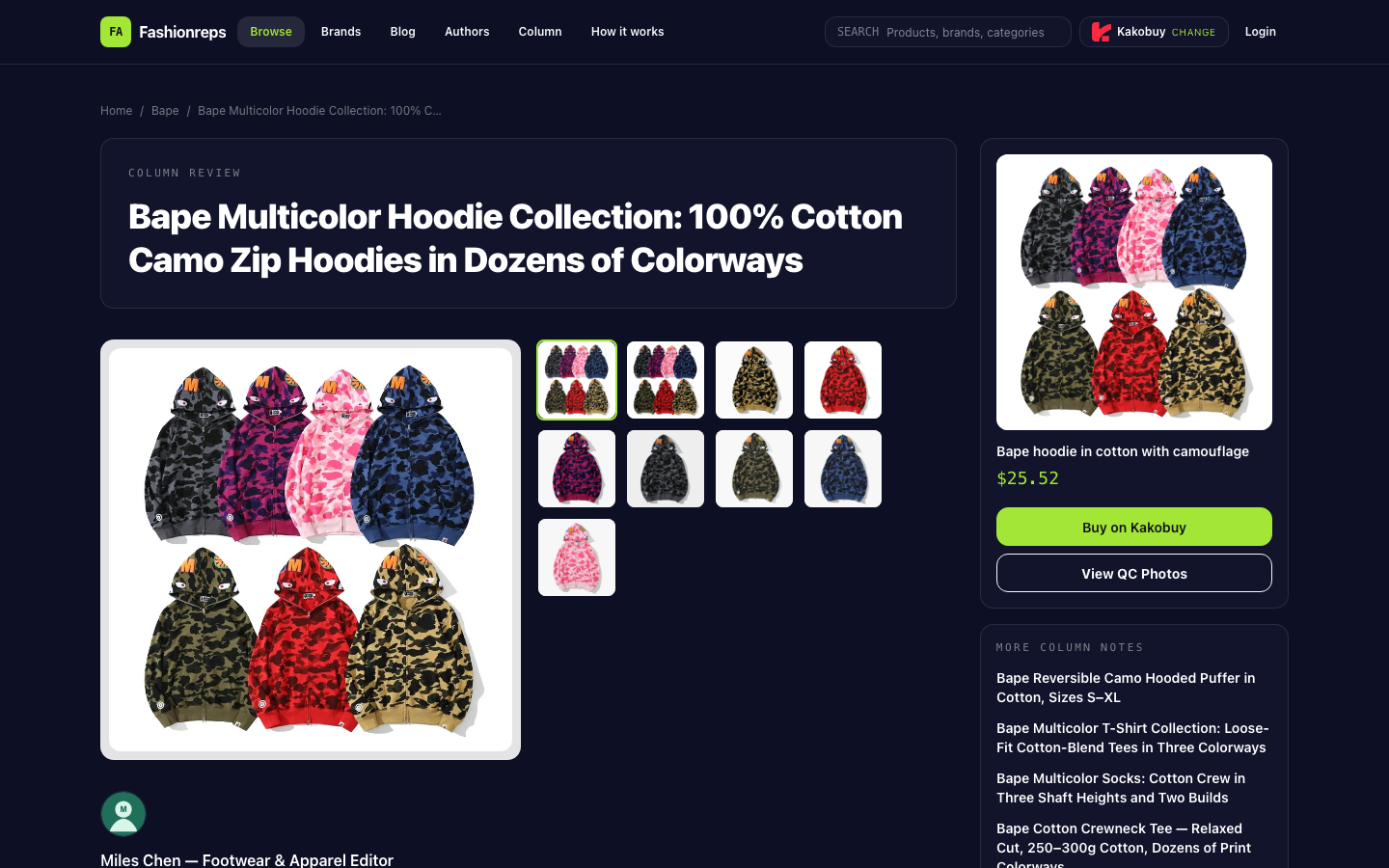
- Published
- Updated
This item is better treated as a "specific style that requires size verification" rather than a basic hoodie that can be ordered directly based on size label alone. The page states it is made of 100% cotton, 250–300gsm, regular thickness, standard colorways typically unlined, and offers sizes M to XXXL; but fit feedback is contradictory, and the item fields themselves have structural description conflicts. 
What the Page Can Confirm
| Item | Page Information | Meaning for Purchase |
|---|---|---|
| Fabric and Thickness | 100% cotton, 250–300gsm, regular thickness | Cannot be directly equated to fleece-lined or winter warmth |
| Structure Description | Hooded, zip front, patch pockets, described as relaxed fit | This information is not entirely consistent with the crewneck field; need to confirm specific variant |
| Size Range | M to XXXL | Size range does not represent actual chest width and length for each size |
| Variants | Camo, character prints, brushed fleece, and the 888 style marked as double-faced heavyweight | Different variants may not have the same thickness or lining structure |
The page also shows a reference price of $25.52; final item price, service fees, and international shipping need to be confirmed on the purchasing agent page, not judged solely by reference price. Stock and availability for different colorways should also be rechecked before ordering.
Why Fit Cannot Be Determined by "M, L, XL" Alone
Existing evidence does not support a unified size conclusion. A buyer weighing about 155 lbs said he usually wears M, but this item in M was "very, very slim" and recommended sizing up; another Chinese discussion considers Bape smaller than other brands, while also describing the hoodie as relaxed. The size reference published on the page also maps M to a height of about 165–175 cm and chest of 96–104 cm, but such ranges cannot replace specific flat measurements.
Therefore, "runs small" and "relaxed body" may appear simultaneously: one of shoulder width, chest width, length, or sleeve type being tight does not mean the entire garment is slim fit. Additionally, Trustpilot buyers reported that sample try-on sizes were inconsistent with actual sold sizes, further reducing the reliability of judging by try-on photos or size labels alone.
Structural Field Contradictions Must Be Resolved First
The page describes a hooded zip front with patch pockets on one hand, and a crewneck field on the other. Based on text alone, it is impossible to tell if this is an input error, leftover from a generic template, or mixed fields for a specific variant.
Before ordering, confirm the following with the seller, and require answers for the selected colorway and size:
- Whether it is indeed a hooded zip style, not a crewneck pullover.
- Whether the chosen colorway is the standard unlined version, brushed fleece, or 888 double-faced heavyweight.
- Whether the zipper runs through the front, and whether the number and placement of patch pockets match the page description.
- Whether the 250–300gsm on the product page applies to the selected variant, not just a summary for the entire group.
If the seller cannot clearly explain why "hooded zip" and "crewneck" appear simultaneously, treat it as incomplete information rather than defaulting to a more ideal structural interpretation.
Suggested Order for Requesting Size Evidence
First, request flat chest width or pit-to-pit width, and garment length. Chest width determines wearing ease, and length affects overall proportion; these two are more suitable for comparison with your existing hoodies than size names.
Second, confirm shoulder width and sleeve length. If shoulder width is narrow, even if chest is sufficient, movement may be restricted; if drop-shoulder design is used, shoulder line position should be confirmed through actual photos or annotations.
Third, request close-up photos of the hood and zipper area. Focus on whether the hood shape is intact, whether the zipper is an actual front-opening structure, and whether the patch pockets, zipper pull, and front placket belong to the selected variant.
Fourth, confirm measurement error. The page notes a possible 1–3 cm error, so critical dimensions cannot be treated as absolute. The safest approach is to lay flat a hoodie that fits you well, measure it, and compare item by item with the seller-provided data.
When to Buy and When to Hold Off
If you have already decided on a specific camo or character colorway, can accept verifying flat measurements first, and do not require every colorway to have fleece or lining, then this item can continue to be evaluated. A low reference price cannot replace accounting for specific variants, service fees, and international shipping.
If you need a clearly slim fit or clearly relaxed fit, cannot accept size discrepancies, or want all colorways to have a stable warmth structure, then you should not order based solely on the current page. Especially when the page's structural fields are still unexplained and the seller has not provided chest width and length for the chosen size, it is advisable to hold off.
Post-arrival risks should also be considered in advance: some buyers reported a slight chemical smell when unpacking new clothes, and airing or washing before wearing is a reasonable precaution; this is only individual feedback and cannot be concluded that all batches have the same issue. Regarding cotton feel, buyer evaluations of different release batches are inconsistent; some think recent cotton is smoother and cooler, indicating possible differences between versions.
Overall, the key for this item is not to guess "should I size up or go true to size" first, but to confirm the structure of the selected variant, then use chest width, length, shoulder width, and sleeve length to judge fit. When size and structure evidence cannot be completed, holding off is safer than relying on contradictory fit descriptions.
Daniel Reyes is Editor-in-Chief, covering cross-border shopping agents, QC photo review, warehouse consolidation, and shipping-line comparison. They write most of the agent-fee and shipping-line explainers, maintain the desk's five-point scoring standard, and sign off on every published score. Each review receives two checks: the order log of agent fee, QC time, shipping line, and arrival date, followed by the bench notes. Before a new score goes live, Daniel compares it with the last six months of retests, connecting the review's explanations, test records, and scoring checks.