Hermes Scarf: Check Size, Pattern, Styling Before Buying
- Published
- Updated
Before buying a Hermes scarf, the most important thing is not to look at promotional language first, but to confirm whether the page provides enough evidence to judge the size, pattern, edge finishing, and actual styling range. This article is for readers who are about to search for products through fashion-reps, and aims to help you complete a documented pre-purchase verification: save the product page, confirm visible information, list missing information, and pause ordering when evidence is i
Editor score 4.2 / 5
Menu
Before buying a Hermes scarf, the most important thing is not to look at promotional language first, but to confirm whether the page provides enough evidence to judge the size, pattern, edge finishing, and actual styling range. This article is for readers who are about to search for products through fashion-reps, and aims to help you complete a documented pre-purchase verification: save the product page, confirm visible information, list missing information, and pause ordering when evidence is insufficient. 🧣
This article does not apply to scenarios that require confirming authenticity, real touch, wearing effect, or long-term seller performance. Page text and images can only support limited judgment and cannot replace physical inspection or official certification.

Specific Judgments to Make Before Buying a Hermes Scarf
Before ordering, at least four questions should be answered:
- Does the page clearly state the scarf's length, width, or size name?
- Can the pattern be identified from multiple clear images, rather than just one distant shot?
- Is there close-up evidence of the edge, rolled hem, fringe, or other visible structure?
- Are these sizes and patterns suitable for your tying method, coat collar type, and usage scenario?
If you can only see the brand name, a blurry image, and a price, at most you can confirm the existence of an item to be checked, but cannot judge size, fabric, thickness, or styling limits from that. 📌
Saving Style, Color, Size, and Current Link from fashion-reps Pages
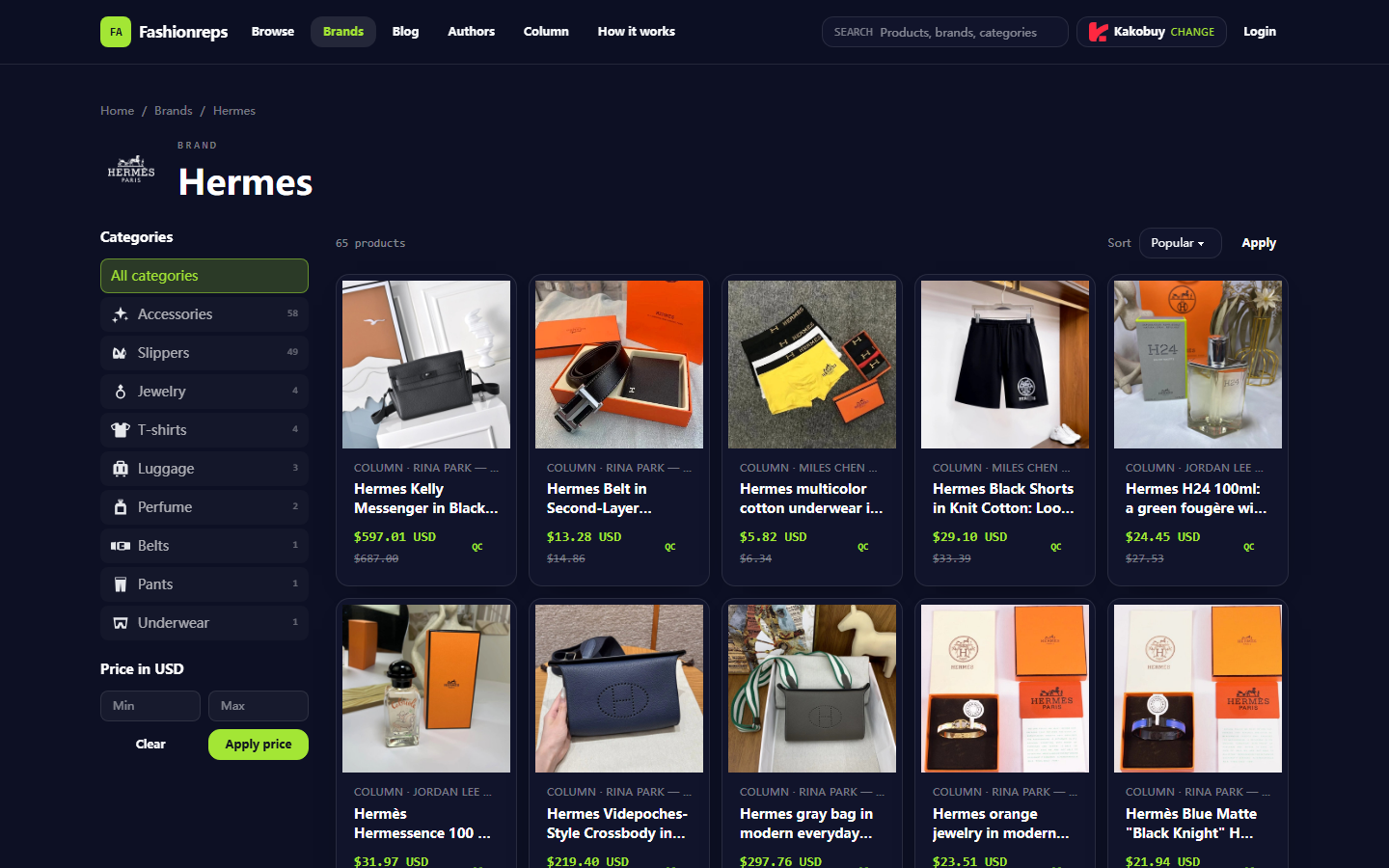
The Hermes brand catalog page on fashion-reps shows 65 products and provides category, price filter, and sorting options. In this page collection record, the visible products mainly include categories such as bags, belts, clothing, shoes, jewelry, and perfume; the existing evidence does not provide a specific product sample that can directly check scarf size, pattern, and material.
Therefore, when looking for a scarf, you should enter the specific product page rather than just saving the brand catalog page. It is recommended to record the following at the same time:
- The original product title and the current page address
- The color, style name, and specifications displayed on the page
- The product main image, detail images, and shooting angles
- The displayed price, stock status, and update time
- Whether a size chart, numeric dimensions, or additional seller notes are provided
- The shopping process or agent link that the buy button currently points to
Keep page screenshots and the verification date when recording. The page evidence verification date for this article is October 20, 2026. Prices, stock, link status, and purchase entrances may change, so what the catalog page shows today cannot be used as a guarantee for future orders. 🔎
How to Check Pattern, Edge Finishing, and Visible Structure Item by Item
Pattern judgment should first confirm the overall layout, then look at local details. You can check in the following order:
- Compare the pattern direction in the main image and detail images to confirm it is the same style, not a mixed image of different colors or versions.
- Observe whether the pattern covers the entire surface, is concentrated in the center, or forms a continuous decoration along the edge.
- Check whether there are independent patterns, text, animals, or geometric elements at the four corners, because these positions affect the visible effect after folding.
- Zoom in on the edge to confirm whether it is a regular rolled hem, contrast color edge, fringe, or an illusion caused by image compression.
- Check the back or folded state. If there is only a front flat lay image, do not infer the back color, double-sided effect, or thickness.
Page images can help you judge visible structure, but cannot prove fiber composition, feel, warmth, or true color difference. Monitors, lighting, and compression can all change color perception. For colors like orange, burgundy, and dark blue that are easily affected by light, it is best to request additional natural light photos or seller confirmation.
How Size Information Affects Tying Methods, Coat Pairing, and Usage Scenarios
Size directly affects whether a scarf can be tied in a certain way, but you cannot rely solely on words like "large" or "small". You should prioritize finding specific centimeters and correlate them with the usage scenario:
| Page Evidence | Judgment It Can Support | Information Still Needed |
|---|---|---|
| Specific length and width numbers | Can preliminarily judge folding area and coverage | Measurement error, whether fringe or edge is included |
| Only size name | Can be used as a style classification clue | Actual dimensions and thickness of that size |
| Only model photos | Can observe approximate wearing method | Model height, true scarf size and proportion |
| Only folded photos | Can judge visual effect after folding | Unfolded size, full pattern, and edge structure |
Smaller sizes are usually more suitable for neck accents, bag handle decoration, or simple knots, but this is just size logic and does not mean the current page product is necessarily suitable. Larger sizes may support shawl-style styling, but can also appear bulky with short jackets, narrow collars, or in smart-casual office settings. Ultimately, you should judge the scarf size, coat collar type, and the tying method you plan to use together. 👗
If the page does not have centimeter measurements, do not use model body shape, the word "classic" in the product title, or image proportions to infer precise size. You can first ask the seller for an unfolded measurement photo, and then decide whether to proceed.
How to Control Conclusions When the Page Lacks Fabric or Thickness Information
When there is no fabric, weight, or thickness description, avoid using definitive descriptions like "soft", "thick", "lightweight", "warm", or "suitable for winter" in the article or purchase record. Draping in images does not prove the actual material, because shooting angle, ironing, and post-processing can affect appearance.
A more reliable way to record is to divide conclusions into three layers:
- What the page explicitly states, such as color, numeric dimensions, or product options.
- What is directly observable in images, such as pattern position or obvious edge decoration.
- What has not been verified, such as fabric composition, feel, weight, breathability, and durability.
This approach avoids writing visual impressions as physical test results and makes it easier to compare item by item with seller Q&A later. ⚠️
Which Check Leads Can Community Feedback Provide
Community discussions are useful for generating a list of issues, but not for independently proving a product's size, material, or quality. When reading feedback, confirm the discussion subject, posting time, and whether the images correspond to the same product, and distinguish between what you fully read and what you only saw as a summary.
You can turn feedback into verification questions, such as:
- Has anyone found a discrepancy between the page-stated size and the measured size?
- Have color or edge finishing variations been mentioned for different batches?
- Do buyers show unfolded photos rather than only folded photos?
- Are comments about the product itself, or about logistics, packaging, or agent service?
Do not treat a single comment, number of likes, or vague "looks good" as a quality guarantee, and do not claim that the community has generally approved the product when you cannot fully read the discussion.
Pre-Publication Review of Product, Price, Stock, and Link Status
Before publishing or ordering, reopen the specific product page and complete a review close to the operation. Key points include:
- Is the product name still consistent with the images and specifications?
- Are the size, color, and stock options still selectable?
- Has the current price, currency, or discount conditions changed?
- Is the page accessible, or is it redirected to an empty page, tag page, or error page?
- Does the buy button still point to an understandable agent process?
- Are there return conditions, out-of-stock notices, or restrictions that need separate confirmation?
The currently visible brand catalog is only enough to show that fashion-reps provides a browsing entry for Hermes product categories. It cannot confirm that a specific scarf is currently in stock, nor can it confirm any specific seller's fabric, quality, or after-sales performance. If the specific product page is inaccessible or lacks sufficient images and size information, record the status as "evidence pending" rather than publishing it as a verified recommendation. ✅
Supplementing Information, Pausing, and Next Steps When Evidence Is Insufficient
When the page lacks key information, request the following from the seller or agent portal: unfolded length and width measurement photos, full pattern images, edge close-ups, natural light color photos, fabric labels or composition descriptions, and current stock confirmation. For personal orders, do not publicly disclose name, phone number, payment card, full shipping label, or other sensitive information.
If supplementary information still cannot confirm size and pattern, pausing the purchase is safer than guessing based on the title. Only when the product page, specifications, images, and current link correspond to each other should you proceed to compare price and shipping conditions.
Completing this verification will not automatically lower the product price, but it can reduce return, exchange, and communication costs caused by unsuitable size, pattern differing from expectations, or missing information. It is more suitable for buyers who need specific tying methods, fixed coat pairings, or who value pattern placement; if you only accept products with confirmed fabric, measured dimensions, and clear after-sales conditions, then any page lacking such evidence should not be used as the final basis for purchase.
Daniel Reyes is Editor-in-Chief, covering cross-border shopping agents, QC photo review, warehouse consolidation, and shipping-line comparison. They write most of the agent-fee and shipping-line explainers, maintain the desk's five-point scoring standard, and sign off on every published score. Each review receives two checks: the order log of agent fee, QC time, shipping line, and arrival date, followed by the bench notes. Before a new score goes live, Daniel compares it with the last six months of retests, connecting the review's explanations, test records, and scoring checks.