Loewe Multicolor Sneakers: Fit and Width Checks
- Published
- Updated
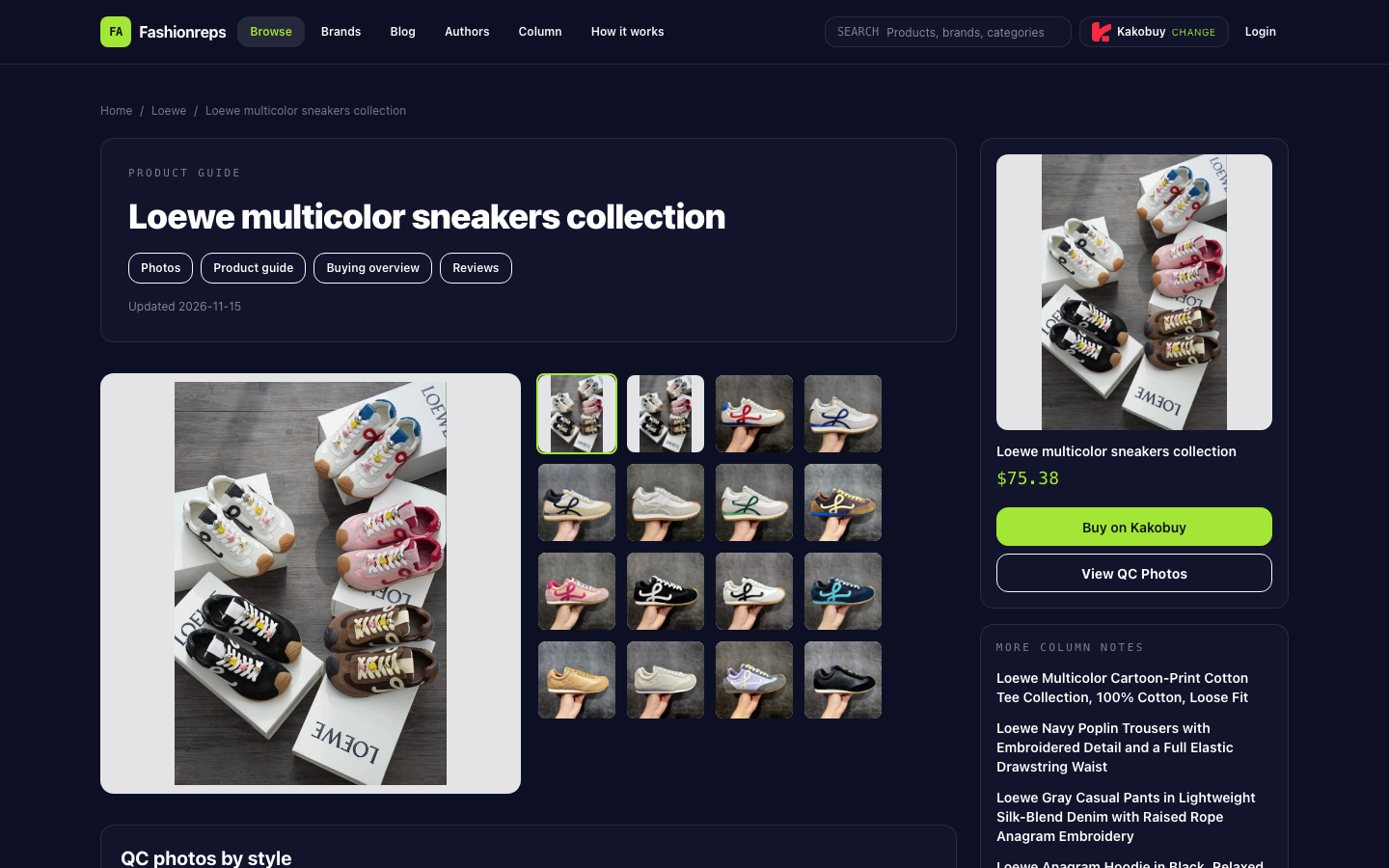
Whether these Loewe multicolor low-tops suit you depends not on the number of colorways, but on two often-overlooked measurements: insole length and forefoot width. The product page shows suede uppers, lambskin lining, and a rubber outsole, offered in black, white, dark brown, blue, and pink, with women's sizes 35–40 and no half sizes. Since the available information is not a first-hand review, the focus below is on how to verify foot shape, sizing, and photo details before buying. 
What the page confirms
This is a women's low-top sneaker with a rounded toe and front lacing. The page classifies it as a flat casual shoe, with heel height listed as 0–3 cm and collar depth about 7 cm. Suede uppers and lambskin lining usually give a soft feel, but material names alone cannot tell you if the last is roomy, nor can they predict support or durability.
The five colorways include easy-to-match black, white, and dark brown, plus bolder blue and pink. The page lists daily casual and all-season wear as suitable scenarios; this is product positioning, not proof of weather resistance. The current information also lacks insole length, widest forefoot measurement, insole thickness, or specific last shape data.
The listed reference price is $75.38. It is not the final cost; service fees, international shipping, and other order charges must be confirmed on the shopping agent platform, so you cannot judge value by reference price alone.
With no half sizes, first assess your foot shape
If your foot length falls between two whole sizes, or one foot is noticeably longer than the other, you cannot just order your usual brand size. A safer approach is to take a low-top shoe you can walk in comfortably without toe pinching, and measure three things:
- Insole length, not total outsole length;
- Inside width at the widest part of the forefoot;
- Vertical space from insole to the highest point of the toe box.
Measure while wearing the socks you plan to pair with these shoes, and do it in the afternoon or evening, as feet can change slightly during the day. Measure each foot separately, and go with the longer, wider foot. If the seller can only provide outsole length, that cannot replace insole length, especially for rounded-toe and lined styles, where there may be unusable space inside the toe box.
The page lists sizes 35–40 with no half sizes. Here's how to decide:
- Foot length clearly in the middle of a whole size, and forefoot on the wider side: prioritize asking for the next size up's insole length and forefoot width, then judge if heel or toe looseness affects walking.
- Foot length near the upper limit of a whole size, toes prone to hitting the front: don't reduce allowance just because you usually buy smaller; confirm the actual measurements of the next size up first.
- High instep or toes needing more room: besides insole length, ask about the highest point of the upper and the lacing area structure, not just the size label.
- Narrow feet: a larger size might solve length but cause heel slippage, so also check heel circumference or request photos of the shoe worn.
Don't treat feedback from other Loewe styles as this model's conclusion
The material mentions that in a multi-brand test involving other Loewe shoes, a size 38 was so loose it slipped off while walking, while a 37 was tight. That feedback was not from this multicolor suede low-top, so you cannot directly infer this model's sizing pattern.
Its only value is this: Loewe styles can have significantly different lasts, so "I usually wear a certain Loewe size" is not enough for this model. You must rely on this model's insole length, forefoot width, and heel hold.
What measurements to ask the seller for before buying
Without half sizes, focus on measurable data rather than asking "true to size?" Ask in this order:
- Insole length for the selected size, stating whether it's measured along the centerline or the maximum usable length.
- Width at the widest part of the insole forefoot, and where it was measured.
- Internal toe box height from insole to upper.
- Heel inner width, collar height, and actual photos of the lacing area.
- Whether all five colorways use the same upper and lining specs.
If the seller only gives a vague "true to size" answer without this model's measurements, buyers between sizes lack sufficient basis. Pausing the purchase is more prudent than deciding solely on reference price or colorways.
What to focus on in QC photos
This shoe has multicolor paneling, so photo checks shouldn't only look for obvious stains. The page suggests examining the heel and toe to judge panel alignment and overall shape. Specifically, check:
- Are the panel seams on the left and right toe boxes at similar positions? Is the rounded toe profile uneven?
- Are the heel logo, heel panel, and midsole edges roughly aligned?
- Are the color zones consistent on both shoes, with no obvious shade differences?
- Are there large creases, flattened nap, or uneven sheen on the suede?
- Are the eyelet positions, tongue length, and front lacing area symmetrical?
- Are there excess glue, lifted edges, or uneven bonding on the rubber outsole?
These photos only help assess appearance details of the item shown; they cannot prove the inner dimensions fit your foot, nor replace actual try-on. Suede color and nap condition are affected by lighting, angle, and nap direction, so you cannot judge actual feel from a single photo.
Which foot shapes and styling scenarios suit this shoe
If you have a regular-width foot, your foot length clearly matches a whole size, and the seller can provide insole length and forefoot width, this shoe can remain a candidate for a daily low-top. The rounded toe and low profile work well with straight-leg jeans; slightly cropped or tapered hems can reveal the multicolor panel details. Black, white, and dark brown blend into a basic wardrobe, while blue and pink rely more on coordinating colors in your outfit.
If you have a wide forefoot, high instep, or often hesitate between sizes, make "seller can provide this model's actual measurements" a prerequisite. If you only see a size range and images, with no way to confirm forefoot width or insole length, you cannot claim it will be comfortable or fit.
Conclusion: check size evidence before ordering
This shoe's strengths are clear material, colorway, and low-top silhouette information, suitable for those seeking a retro-inspired daily shoe that pairs with straight-leg jeans. What it needs most is not more marketing copy, but insole length, forefoot width, and heel hold data for your selected size.
If the seller can provide those actual measurements and they are close to your well-fitting shoes, you can continue comparing colors and QC photos. If you must guess based on the 35–40 whole-size range, reference price, and feedback from other Loewe styles, the risk of no half sizes remains high; it's better to pause the purchase.
Daniel Reyes is Editor-in-Chief, covering cross-border shopping agents, QC photo review, warehouse consolidation, and shipping-line comparison. They write most of the agent-fee and shipping-line explainers, maintain the desk's five-point scoring standard, and sign off on every published score. Each review receives two checks: the order log of agent fee, QC time, shipping line, and arrival date, followed by the bench notes. Before a new score goes live, Daniel compares it with the last six months of retests, connecting the review's explanations, test records, and scoring checks.