Nike Fall/Winter Jacket Guide: Fashionreps & Google Sheets
- Published
- Updated
Introduction If you're looking for Nike fall/winter jackets, the real challenge usually isn't finding a few product names—it's organizing brand, season, style, images, specs, links, and verification status into a record that still makes sense before you place an order. This guide solves a specific problem: how to first discover candidates in the product catalog on fashion-reps.net, then use Google Sheets to build a filterable, collaborative, and traceable verification sheet. After reading, you s
Editor score 4.2 / 5
Menu
Introduction
If you're looking for Nike fall/winter jackets, the real challenge usually isn't finding a few product names—it's organizing brand, season, style, images, specs, links, and verification status into a record that still makes sense before you place an order. This guide solves a specific problem: how to first discover candidates in the product catalog on fashion-reps.net, then use Google Sheets to build a filterable, collaborative, and traceable verification sheet.
After reading, you should be able to do three things: filter candidates that meet the Nike, fall/winter, and jacket criteria; keep product pages, images, and spec evidence for each candidate; and clearly mark unverifiable information as "to be verified" instead of mistaking it for confirmed information. This article is not for people who already have complete supplier links and just need to batch import orders, or who want to judge material and authenticity directly from unverified images.
As of October 13, 2026, this guide is based on the catalog navigation, search entry, product pages, and QC image pages visible on fashion-reps.net. Product inventory, prices, sizes, materials, seller information, and external purchase platform status may change, so you still need to reopen pages to confirm before actually ordering. 🔎

Tasks for This Nike Fall/Winter Jacket Filtering
First, write the task as executable conditions rather than just "find Nike jackets." It's recommended to break the filtering goal into the following items:
- Brand condition: The page name, brand category, or other visible fields can support the Nike determination.
- Category condition: The product should be a jacket or outerwear, not just inferred from color or sporty style.
- Season condition: The page text, structure description, or image information can indicate it's suitable for fall/winter layering; if the page has no clear season information, mark it as to be verified.
- Evidence condition: Keep at least the product page, visible product name, and one spec or image evidence.
- Decision condition: Each candidate must end up in one of three categories: keep, to be verified, or exclude.
The website catalog is for discovering candidates, and Google Sheets is for organizing judgments. Don't mix them into one step: the sorting and visible content in the catalog can change, while the verification records in the sheet should preserve the facts you saw at a certain point in time.
A qualified candidate record isn't "looks like a fall/winter jacket," but one that can answer these questions: Which page does it come from? What is it called on the page? Why is it included? What information is still missing? What should be checked next?
Catalog, Images, and Links to Verify in the Fashionreps Website Spreadsheet
Here, "Spreadsheet" should be understood as a website-type product catalog or list view, not as an electronic spreadsheet that already has all the functions of Google Sheets. fashion-reps.net pages show Browse, Brands, Blog, Authors, and a search entry, and also provide product pages, QC image pages, and shopping agent selection entry. The page also indicates that orders, payments, and shipping are handled by the selected agent website, so there is a clear boundary between the website catalog and the actual purchase process.
In the catalog, first complete discovery and initial screening:
- Use the search entry to input natural words like Nike, jacket, winter jacket, puffer, windbreaker, shell, then check one by one whether the results really are jackets.
- Narrow down through brand or category entries, but don't treat brand filter results directly as season filter results.
- Open the product detail page to confirm the product name, visible specs, images, and page status.
- If the page provides a QC gallery or similar image entry, check whether the images correspond to the current style, not other styles from the same source.
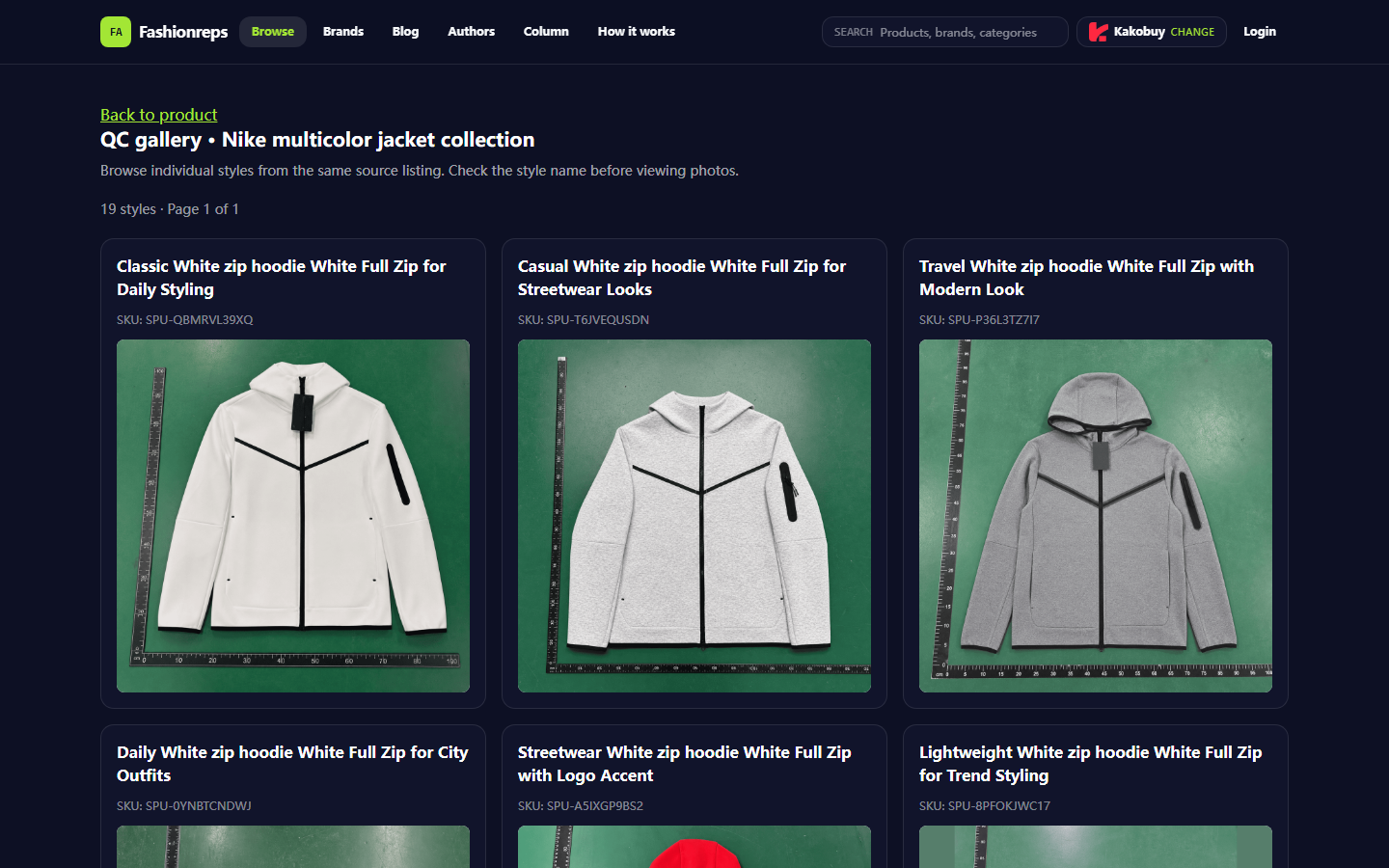
- For collection pages containing multiple styles, first confirm the specific style name, then record the corresponding images and SKU. Example pages show that a source list may contain multiple independent styles, so don't save only the collection page title.
- Record the date the page was opened. Product names, links, inventory, and external agent entries may change.
The provided page evidence shows that a certain Nike-related QC collection page lists multiple independent styles and requires checking the style name before viewing photos. This fact only supports the judgment that "the page has a multi-style QC collection," and cannot prove that every style is a fall/winter jacket, nor that the images can confirm material, size, or authenticity.
When verifying images, it's recommended to only record what the images can directly support, such as color, silhouette, zippers, or pockets and other visible structures. Don't write image observations as material conclusions after touching, and don't claim warmth, waterproofing, authenticity, or suitability for a certain temperature range based solely on images.
How to Set Up Brand, Category, and Verification Status Columns in Google Sheets
Google Sheets is better for saving structured records, setting filters, adding collaborators, and maintaining follow-up status. Table columns should serve decision-making, not pile up keywords. You can start with the following fields:
| Field | Recording Method | Purpose |
|---|---|---|
| Brand | Nike, To Confirm | Filter brand, avoid misclassifying similar styles as Nike |
| Category | Jacket, Down Jacket, Windbreaker, Other, To Confirm | Distinguish product type |
| Season Cues | Page Explicit, Image Inference, Not Stated | Distinguish visible facts from personal judgment |
| Product Name | Name visible on original page | Preserve source text, don't rewrite into conclusions |
| Product Link | Product detail page URL | Convenient for re-verification |
| QC Image Link | Corresponding style image or QC page | Save image evidence entry |
| SKU or Style Name | Value visible on page | Distinguish different styles in collection pages |
| Price and Currency | Value shown on original page and verification date | Prevent treating old prices as current |
| Size Info | Size visible on page or Not Provided | Leave room for subsequent size verification |
| Image Evidence | Yes, Partial, No | Determine if comparison can continue |
| Verification Status | To Be Verified, Verified, Excluded | Control next actions |
| Items to Confirm | Free text | Clarify what evidence is missing |
| Last Verification Date | YYYY-MM-DD | Determine if record needs refresh |
"Season Cues" and "Verification Status" should be separate. A product may look suitable for fall/winter, but the page doesn't clearly state it; then Season Cues can be "Image Inference," but Verification Status should remain "To Be Verified."
It's recommended to use data validation to create fixed status values to reduce multiple ways of writing the same meaning. For example, use only "To Be Verified," "Verified," and "Excluded," not synonymous statuses like "Unconfirmed," "Pending Confirmation," "Not Checked Yet." 🗂️
Filtering Steps for the Same Candidate on Website Page and in Sheet
Recommended cycle of "website discovery, sheet judgment, page re-check":
Step 1: Build Candidate Pool
On fashion-reps.net, search with brand words and category words, and first save potentially relevant pages. Don't rush to judge whether to buy in the first round. The purpose of the candidate pool is to avoid recording only the first few results that appear.
Step 2: Open Detail Pages One by One
Open the product detail page to check page name, visible images, specs, links, and update time. If the product name is not enough to confirm it's a jacket, keep the candidate in the sheet but mark category as "To Confirm."
Step 3: Check Images and Specific Styles
If the page links to a QC gallery or multi-style collection page, you must record the specific style name, SKU, or other visible identifier together. Don't use the generic title of the collection page as a substitute for the specific candidate name.
Step 4: Fill Back into Google Sheets
Put visible facts from the page into corresponding columns, and put judgments and gaps into separate columns. Recommended wording:
- Page clearly shows brand, record as "Confirmed: page name contains Nike" or quote the visible brand field.
- Page only shows sport outerwear but no season description, record as "Fall/winter attribute to be verified."
- Page has images but no size chart, record as "Images present, size evidence missing."
- Page link fails, redirects abnormally, or product content is empty, record as "Excluded: page unavailable," and keep the check date.
Step 5: Filter by Status
First filter "Verified" to see candidates that can move to the next comparison, then filter "To Be Verified" to focus on missing information. Don't delete "To Be Verified" rows, because these records show what you've already checked and avoid reopening the same page.
How to Keep Evidence for Product Links, Specs, and Update Time Item by Item
Each candidate should have at least three types of evidence: page evidence, image evidence, and time evidence.
Page evidence answers "What is this?" Save the product name, page URL, brand or category field, and specs explicitly shown on the page. If the page lacks certain information, fill in "Not Provided," don't fill it in yourself.
Image evidence answers "What does the page show?" Save the image entry corresponding to the current style, and note what visible judgments the images can only support. For example, images can help check color and overall structure, but cannot independently prove fabric composition, warmth level, inventory, or authenticity.
Time evidence answers "When was this information seen?" At least record the date the page was last opened. Price, inventory, product link status, size, and external agent entry are highly volatile information, and when necessary, add specific time and currency.
| Verification Item | What Can Be Confirmed | What Cannot Be Directly Inferred |
|---|---|---|
| Product Name | Name currently displayed on page | Brand authenticity or official authorization relationship |
| Images | Color, visible structure, whether images correspond to style | Actual material feel, durability, warmth performance |
| Size Chart | Size values provided on page | Wearing effect or personal fit |
| Price | Amount and currency shown at a visit | Long-term price, final shipping and taxes |
| QC Page | Page has corresponding photos or collection entry | Images definitely represent current inventory |
| Shopping Agent Entry | Options or jump choices provided on page | Agent's real-time inventory, service quality, and final cost |
If page content changes, update the verification date of the original record and explain the change in notes; don't silently overwrite old judgments. For fields that still cannot be confirmed, using "To Be Verified" is more valuable than filling in speculative values.
Applicable Boundaries of Both Methods for Mobile Browsing and Deep Organization
The website catalog is more suitable for quick discovery on mobile. You can search brands, browse images, open product pages, and add interesting candidates to a later list. But mobile browsing is not suitable for long-term comparison of multiple fields, and it's easy to miss page names, style names, and link status.
Google Sheets is better for deep organization. It can filter by brand, category, verification status, and update time, and also facilitates collaboration to supplement evidence. The disadvantage is that the sheet itself does not automatically prove that the page content is correct; if you don't go back to the original page to re-check, the sheet may just be a neater way of saving old information.
Therefore, the more stable boundaries are:
- Mobile browsing: discover candidates, view images, open pages, record initial links.
- Google Sheets: compare candidates, assign verification tasks, mark missing fields, record update time.
- Product page: confirm current visible name, specs, images, and link status.
- External agent website: confirm actual ordering, payment, shipping, and delivery conditions.
Don't interpret "Verified" in Google Sheets as platform certification, and don't interpret the catalog content on fashion-reps.net as inventory or fulfillment results promised by external agents. 📱
How to Mark "To Be Verified" When Page Evidence Is Missing
"To Be Verified" is not a failure status, but an accurate description of insufficient evidence. It's recommended to write specific questions in "Items to Confirm," for example:
- No clear Nike brand field found, need to re-check page title or category.
- Page shows outerwear, but doesn't state whether it's for fall/winter.
- Has collection page and QC images, but not yet confirmed which specific style the photos correspond to.
- Page has product name, but no size chart.
- Price exists, but no currency or verification date recorded.
- Product page opens, but external purchase entry status not yet confirmed.
- Images visible, but cannot judge fabric, filling, waterproofing, or authenticity from them.
If a link returns 404, redirects to an irrelevant page, page is empty, or only has tags without clear product information, mark the record as "Excluded: insufficient page evidence" instead of continuing to treat it as a valid candidate.
For multi-person collaboration, you can add "Owner" and "Reviewer" columns for each row. The reviewer only needs to check whether the original page matches the sheet, and should not change speculation to confirmation without new evidence. This reduces repeated page openings and preserves judgment basis. ✅
Pre-Order Action Checklist After Combined Use
After completing website filtering and sheet organization, process remaining candidates in the following order:
- Filter candidates whose brand, category, and page evidence all meet requirements.
- Check that each candidate has a corresponding product detail page, not just a collection page or search result.
- Verify that images match the specific style name or SKU.
- Re-confirm price, currency, size, inventory prompts, and link status, and update verification date.
- Keep "To Be Verified" status for candidates lacking size, material, inventory, or season evidence.
- Before entering external purchase agent, separately confirm shipping, taxes, route restrictions, return/exchange conditions, and actual payment amount.
- Don't under-declare, split orders to avoid taxes, or submit false declarations to evade checks; customs requirements should follow destination country rules and carrier requirements.
- Save necessary product pages and order information before ordering, but don't disclose payment cards, passports, full waybills, or other sensitive personal data in shared sheets.
The main time saved by this combined method is organization time: the website catalog reduces the cost of discovering candidates from scratch, and Google Sheets reduces information loss during repeated checks and multi-person collaboration. The added risk is that the sheet may save old links, old prices, or unchecked judgments, especially when users mistake "recorded" for "verified."
This method is more suitable for people who need to compare multiple Nike fall/winter jacket candidates, need to collaborate with colleagues, or want to keep evidence before ordering. Not recommended to rely solely on this method in situations such as: page evidence is obviously incomplete, the product involves high-value decisions, size and material have a large impact on the result, or the user cannot re-access the original product page. In these cases, pause ordering and first complete evidence for pages, specs, and transaction conditions.
The final judgment should be based on the currently accessible product page, the actual agent page, and the applicable rules of the destination country, not on image impressions or old records in the sheet.
Daniel Reyes is Editor-in-Chief, covering cross-border shopping agents, QC photo review, warehouse consolidation, and shipping-line comparison. They write most of the agent-fee and shipping-line explainers, maintain the desk's five-point scoring standard, and sign off on every published score. Each review receives two checks: the order log of agent fee, QC time, shipping line, and arrival date, followed by the bench notes. Before a new score goes live, Daniel compares it with the last six months of retests, connecting the review's explanations, test records, and scoring checks.