Valentino Accessories: Check Packing Costs & Rates
- Published
- Updated
 This cost check isn't meant to directly conclude that package consolidation is always cheaper; instead, it's about recording every possible fee for [Valentino](https://fashion-reps.net/brand/valentino) [accessories](https://fashion-reps.net/accessories) from the product page to final payment, then deciding whether the current information is enough to supp
Editor score 4.2 / 5
Menu

This cost check isn't meant to directly conclude that package consolidation is always cheaper; instead, it's about recording every possible fee for Valentino accessories from the product page to final payment, then deciding whether the current information is enough to support a consolidation decision. It applies to buyers who plan to view Valentino accessories on fashionreps and have a chosen shopping agent handle ordering, payment, and international shipping.
This article only covers cost checks and doesn't replace real-time quotes from the agent, destination country tax explanations, or platform policies. Product prices, stock, packaging status, exchange rates, and shipping fees may change; recheck the relevant pages and agent settlement page before ordering. 🧾
Cost decisions this Valentino accessory consolidation must resolve
Before consolidating, three questions need answers:
- Does consolidation reduce duplicate fixed fees or first-weight charges?
- Do packaging, volumetric weight, route restrictions, or parcel value introduce new costs and risks?
- After changes in exchange rates and payment fees, does an originally cheaper option still fit the budget?
fashionreps' brand page shows that product discovery and comparison happen on fashionreps, while ordering, payment, and shipping are handled by an external shopping agent chosen by the buyer. Therefore, reference prices on fashionreps can't be directly equated to final delivered cost, nor can they alone prove one consolidation method is cheaper.
If you only see product reference prices without agent-side packing fees, storage fees, international shipping costs, payment fees, or real-time exchange rates, mark the result as "pending quotation" rather than drawing a definite savings conclusion. 🔎
Verify styles, variants, and visible merchandise value on fashionreps product pages
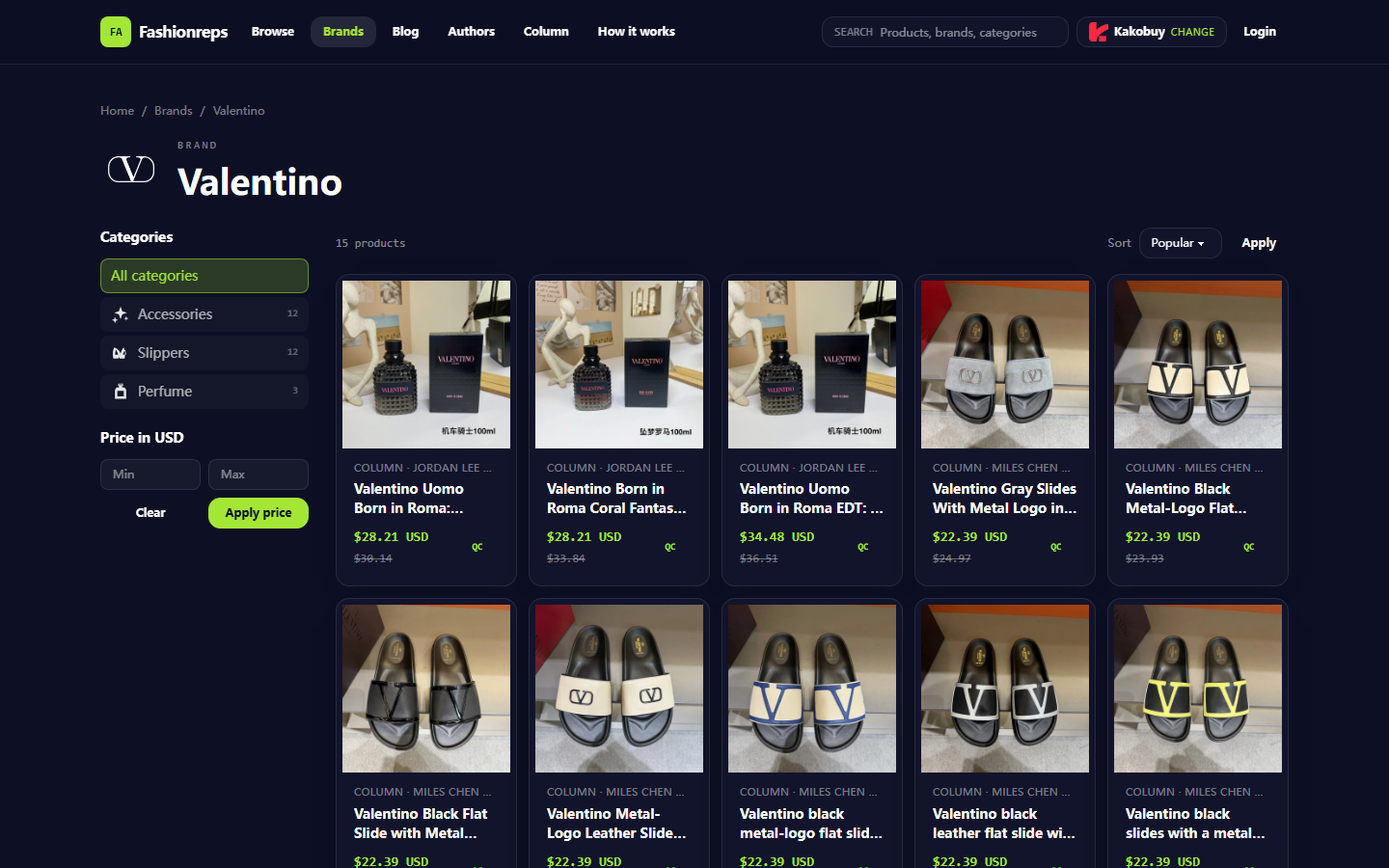
The brand page currently shows 15 products under Valentino, including categories like accessories, slippers, and fragrances. Visible reference prices are in USD, with several Valentino metal-logo flat slippers listed at $22.39; the page also shows some previous reference prices, but this information can't be treated as currently available discounts or final transaction prices.
When building a consolidation list, keep the following for each item:
- Product name and corresponding product page
- Product category and style description
- Available sizes or other variant details
- Current reference price and currency
- Whether the page shows previous reference prices
- Selected shopping agent
- Actual product price, stock, and availability shown on the agent's side
Several slipper names on the page are similar; some descriptions mention black, metal logo, leather or calfskin upper, rubber outsole, and EU sizes 39–45. Don't merge different products based solely on similar titles, nor assume size, material, packaging, or weight are identical just because reference prices are the same.
The page also lists fragrances like Valentino Uomo Born in Roma Mineral-Woody Signature, Born in Roma Coral Fantasy Men's Fragrance, and Valentino Uomo Born in Roma EDT. Fragrances and slippers may differ in packaging, shipping restrictions, and possible route conditions, so don't assume they can be placed in the same package without confirming agent rules.
Record packaging method, parcel conditions, and possible fee fields
Before consolidating, create a fee record. Each field should distinguish "verified," "agent quoted," "to be confirmed," and "not applicable" to avoid treating blanks as zero fees.
| Fee or condition | What to record | Currently confirmable scope |
|---|---|---|
| Item price | Selected item, variant, quantity, currency, settlement price | Some USD reference prices visible on fashionreps brand page; final price needs agent confirmation |
| Agent service fee | Calculation method, minimum charge, or order conditions | No uniform real-time rate provided in current materials |
| Packing fee | Original packaging, removal of outer packaging, reinforcement, special handling, etc. | No specific quote provided |
| Storage or handling fee | Inbound, storage period, outbound, or extra handling conditions | No specific quote provided |
| International shipping | Billable weight, volumetric weight, route, surcharges, insurance options | Must be confirmed by chosen agent and destination country conditions |
| Payment fees | Payment channel, exchange rate spread, card or third-party payment surcharges | No specific rates provided |
| Taxes and customs | Destination declaration, import restrictions, taxes, required documents | Need confirmation based on destination country and shipping route |
| Risk changes | Parcel value, loss or damage impact, route restrictions | Need evaluation based on items and agent rules |
Consolidation may reduce duplicate first-weight charges or handling costs, but it may also increase package weight, volumetric weight, declared value, and single-loss risk. Splitting packages may increase fixed fees but could avoid route restrictions, size limits, or shipping conditions for certain items.
Therefore, packaging decisions should at least record number of packages, estimated billable weight, dimensions, whether to keep item boxes, whether reinforcement is needed, whether special categories like fragrances are included, and agent restrictions on consolidated packages. Without these conditions, reliable comparison between consolidation and splitting is impossible.
Check exchange rates, payment fees, and applicable time from official pages
Reference prices are in USD, but actual payment may be in CNY, USD, or other currencies. When verifying, record:
- Exchange rate source or conversion price shown on payment page
- Date and time of the exchange rate
- Currencies used for item price, agent fee, packing fee, and shipping fee
- Whether payment channel charges extra fees or has exchange rate spread
- Validity period of quotes
- Whether settlement uses platform rate, agent rate, or payment institution rate
Don't treat search engine results, historical orders, or memory as current exchange rates. If official pages or agent settlement pages don't specify the applicable time, mark the exchange rate field as to-be-confirmed and recheck before payment.
Exchange rate changes alone can alter consolidation judgment: even if item price stays the same, the converted local currency amount may change; if packing and shipping fees use another currency, a second conversion may occur. Payment channel fees may also make the nominal rate differ from actual deduction. 💱
Organize item prices, service fees, packing fees, and shipping fees in a unified currency
When comparing, choose a unified currency first, then convert all fees to the same basis. It's recommended to keep original currency amounts while adding converted amounts and exchange rates used, to avoid losing traceability.
Organize in this order:
- Sum the actual settlement prices of selected items; don't use previous reference prices from the brand page as current prices.
- Separately record agent service fees, storage fees, packing fees, and other handling fees.
- Record international shipping based on agent settlement page, noting whether billed by actual weight, volumetric weight, first weight, additional weight, or route.
- Add payment channel fees and exchange rate spread; if the page doesn't provide clear values, don't arbitrarily fill zeros.
- Separately record possible taxes, customs fees, or other delivery-side expenses based on destination country conditions.
- Calculate totals for consolidation and splitting separately, keeping unconfirmed items as ranges or pending quotation status.
With only USD reference prices from product pages and no real-time packing and shipping quotes from the agent, at most you can complete preliminary archiving of product samples; you cannot calculate reliable savings or guarantee consolidation yields a lower total.
When to pause savings judgment due to missing information or changed conditions
If any of the following occurs, pause the "consolidation is cheaper" judgment:
- Product pages only have reference prices, without current transaction prices or availability on agent side
- Different variants' weight, packaging dimensions, or stock status unconfirmed
- Agent hasn't specified fees for consolidation, box removal, reinforcement, or special packaging
- Shipping rules don't explain billable weight, route, surcharges, or insurance conditions
- Exchange rate lacks source, time, or applicable currency
- Items possibly subject to shipping restrictions, like fragrances, lack route confirmation
- Destination country taxes, customs requirements, or import restrictions unclear
- Consolidated parcel value and loss risk increase significantly, but insurance or compensation rules unknown
Pausing doesn't mean you can't buy; it means keeping current cart, product pages, and quotes until missing conditions are filled. If prices, stock, agent, exchange rates, or routes change, recalculate instead of relying on old conclusions. ⏸️
Pre-consolidation fee evidence checklist
Before payment, recheck in this order:
- Confirmed name, variant, quantity, and current settlement price for each item
- Distinguished fashionreps reference price from agent-side actual quote
- Recorded agent name and applicable order and shipping pages
- Confirmed existence of packing, box removal, reinforcement, storage, and handling fees
- Confirmed estimated weight, volume, and billing method after consolidation
- Recorded international shipping route, currency, validity period, and additional conditions
- Recorded payment channel fees and actual exchange rate source
- Checked destination country taxes, customs, and restricted item requirements
- Compared total cost, risks, and applicable conditions between consolidation and splitting
- Saved quote screenshots or order details, with order number, address, phone, and payment info covered
If any field lacks evidence, write "to be confirmed" explicitly; don't substitute zero, estimates, or old quotes. 📋
Next actions after completing verification
After recording, first confirm items are still purchasable in the chosen shopping agent, then obtain real-time settlement details including item price, service fees, packing handling, international shipping, and payment fees. If items include fragrances or other potentially restricted goods, confirm destination country and route suitability first.
Only when both consolidation and splitting have comparable quotes, unified currency, and same fee basis is it appropriate to make savings judgment. The conclusion must clearly state: estimated savings amount, new risks from consolidation, who the plan suits best, and under what conditions consolidation is not recommended.
From currently visible materials, what can be confirmed is the Valentino brand page's product categories, some product names, and USD reference prices; packing fees, agent service fees, international shipping, exchange rate applicable time, and destination country fees still need verification in agent settlement and official shipping information. Therefore, the next step is to obtain real-time quotes and complete evidence recheck, not to confirm a consolidation plan based solely on page reference prices.
Daniel Reyes is Editor-in-Chief, covering cross-border shopping agents, QC photo review, warehouse consolidation, and shipping-line comparison. They write most of the agent-fee and shipping-line explainers, maintain the desk's five-point scoring standard, and sign off on every published score. Each review receives two checks: the order log of agent fee, QC time, shipping line, and arrival date, followed by the bench notes. Before a new score goes live, Daniel compares it with the last six months of retests, connecting the review's explanations, test records, and scoring checks.