White Button Shirt Flat-Lay: Color and Display Styling
- Published
- Updated
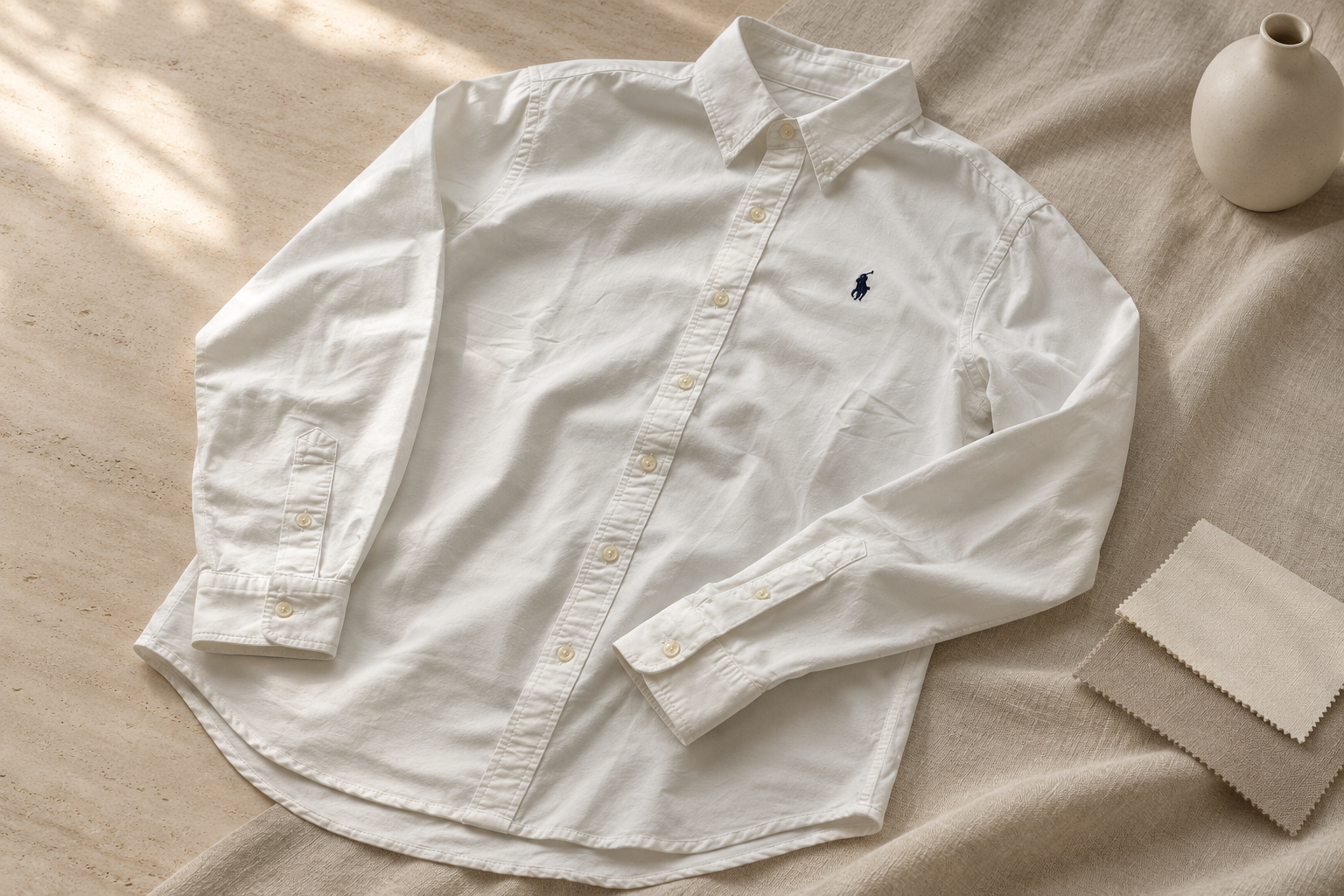
First, Look at the Color Relationships in the Image This flat-lay photo features a white long-sleeve button shirt as the main subject, set against a background of off-white, light sand, and taupe fabrics, creating an overall low-saturation warm tone. The small dark equestrian motif on the chest becomes the most prominent contrast point in the image, preventing the large white shirt from looking monotonous. 
If you want to replicate this color scheme, place the white shirt on a warm beige or light taupe base cloth, and add a few dark details as visual anchors. Accessories should be minimal; in this image, the terracotta-colored small bottle and folded fabrics maintain a soft, restrained color palette without stealing attention from the shirt.
Flat-Lay Details of the Shirt
The shirt is fully spread out on its front, with the collar, center front placket, buttons, cuffs, and curved hem all clearly visible. The buttons run vertically along the front placket, and the cuffs feature a single-button design. A small dark motif on the chest is positioned on the right side of the shirt body, creating a simple decorative focal point.
Noticeable natural wrinkles are visible across the body and sleeves, giving the flat lay a soft, layered texture. The sleeves are arranged in a crossed style, with one side extending downward and the other laid horizontally beneath the body, allowing both the cuffs and the overall silhouette to be shown. The curved hem and edge stitching are also clear, making it useful for observing the overall display effect.
Three Styling Ideas for Display
- Warm beige base cloth: Ideal for highlighting the brightness of the white shirt. You can leave some wrinkles to add a lived-in, layered look; choose terracotta, light brown, or cream accessories.
- Light taupe fabric: Creates a softer contrast in lightness between the white shirt and the background. Slightly overlap the sleeves and expose the collar, cuffs, and curved hem for a neater composition.
- White with dark accents: If you want to emphasize the small dark motif on the chest, use narrow accessories in dark navy or black as accents, but keep the area small to avoid diverting attention from the shirt.
Clothing Styling Suggestions
This type of white long-sleeve shirt works well with the minimalist approach seen in the image. For bottoms, you can choose light khaki, taupe, navy, or black to continue the neutral palette; for a lighter overall look, pair with off-white or light gray bottoms, but it's best to differentiate the top and bottom through texture or shade.
For shoes and accessories, use small accents in brown, navy, or black to echo the chest motif. If adding an outer layer, opt for simple structured pieces like a khaki jacket, dark knit cardigan, or light taupe outerwear, and avoid adding too many bold patterns.
Note that this image can only be used to assess color, display method, and visible appearance details. A flat-lay photo alone cannot confirm the actual fit, on-body effect, fabric composition, thickness, comfort, durability, post-wash performance, size, price, stock, authenticity, or specific model.
Daniel Reyes is Editor-in-Chief, covering cross-border shopping agents, QC photo review, warehouse consolidation, and shipping-line comparison. They write most of the agent-fee and shipping-line explainers, maintain the desk's five-point scoring standard, and sign off on every published score. Each review receives two checks: the order log of agent fee, QC time, shipping line, and arrival date, followed by the bench notes. Before a new score goes live, Daniel compares it with the last six months of retests, connecting the review's explanations, test records, and scoring checks.